
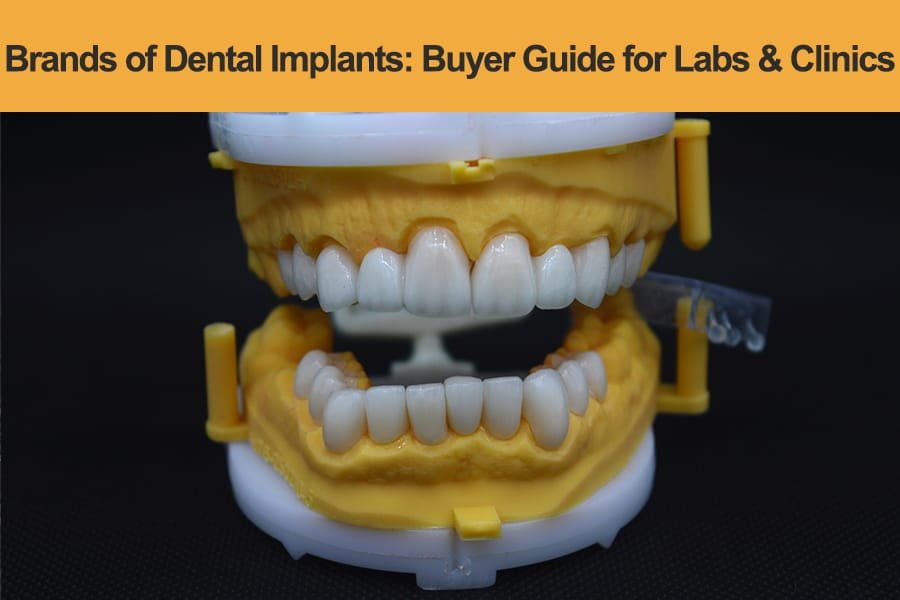
Section 1: Why Brands of Dental Implants Matter
When you compare brands of dental implants, you’re not comparing logos—you’re comparing how stable your implant workflow will be. In real cases, they affect three daily priorities: fit, parts availability, and how smoothly cases move from surgery to the final restoration.
1) Consistent fit reduces chairside problems
Different brands use different connection designs and manufacturing tolerances. In simple terms: some systems seat more consistently and feel more “repeatable” across cases. Better consistency usually means fewer surprises—less adjustment, less rework, and fewer delays at delivery.
2) Parts availability protects your turnaround time
An implant case is not only the fixture. You also need parts like scan bodies, analogs, Ti-bases, screws, drivers, and multi-unit abutments. If any one of these is hard to source, your case can stall. This becomes critical for full-arch cases, where one missing component can stop the whole workflow.
3) Real cost is more than the fixture price
The lowest fixture price does not always mean the lowest annual cost. Training, instruments, component prices, remake risk, and service parts all add up. Strong implant systems tend to reduce hidden costs by keeping workflows stable and predictable.
Key idea: you are purchasing a system that needs to perform reliably—not just an implant fixture.
Section 2: The Implant “Brand” Landscape in One View
To compare brands of dental implants clearly, think of each brand as a full platform. Most established brands offer more than implants—they provide the parts, tools, and digital support needed to finish cases consistently.
Premium systems vs. value-focused systems
Premium systems usually offer:
- Wide component options (including full-arch parts)
- Strong training and technical support
- Stable supply and long-term continuity
- Proven workflows that are easier to standardize across teams
Value-focused systems often aim to reduce upfront cost. Many work well in routine cases, but you should confirm the “system behind the implant,” including:
- Whether key components are always in stock
- Whether digital libraries and scan bodies are easy to access
- Whether full-arch components (like multi-units) cover your needs
A simple way to frame it: premium systems often reduce operational risk; value systems can work well when the ecosystem is verified.
Why brand popularity changes by region
Brands are not popular only because of design. They are also popular because of practical reasons like:
- Local distributor inventory and delivery speed
- Training availability (what clinicians commonly learn)
- Pricing and regulatory access
- Local habits in restorative protocols
So the “most common brand” in one market may not be the most common in another.
What really differs between implant brands (a simple buyer checklist)
When you compare brands, focus on these four areas:
- Connection platform: how the implant and abutment fit together and how stable it is in daily use
- Prosthetic options: Ti-bases, abutments, screws, multi-units (angles and heights), and repair parts
- Digital readiness: scan bodies, CAD libraries, and how well it works with your workflow
- Long-term serviceability: consistent availability and the ability to support repairs years later
Key idea: the best brand for you is the one that keeps your workflow stable—across cases, across clinicians, and over time.
Section 3: Brands of Dental Implants You’ll See Most Often

The implant market is full of choices, but only a smaller group of brands of dental implants keeps showing up in clinics and lab prescriptions. That’s because these brands are more than implant fixtures. They’re complete platforms—the implant system plus the matching prosthetic parts, instruments, and digital support that help your team restore cases the same way, case after case.
When a case says “Brand X,” it usually tells you what kind of system support and workflow you can expect—not whether it’s “good” or “bad”, and more about how easy the system is to run consistently.
In many countries, the clinic purchases the implant fixture, while the dental lab makes the restoration work by matching the correct scan body, Ti-base/abutment, screws, and CAD library. That’s why this list explains what each brand typically means for restoration predictability.
The brands below are the ones you’re most likely to see on real purchase orders. This is not a ranking. Use it as a shortlist to compare platforms and avoid common surprises later—wrong components, delivery delays, and extra chairside adjustments.
Straumann
When you see Straumann, it usually means the clinic is working with a well-established system and expects a smooth, standardized restoration workflow. These cases are often easier to repeat at scale because the ecosystem is mature and the restorative steps are more consistent.
Nobel Biocare
When you see Nobel Biocare, it often signals a more structured workflow—especially in advanced cases such as full-arch. Clinics using Nobel often expect tight planning alignment and accurate component matching. For labs, the key is discipline: confirm the platform and keep the restorative pathway consistent.
Dentsply Sirona Implants
This name usually means “large ecosystem,” but also “multiple systems.” In real cases, “Dentsply Sirona” can refer to different implant systems under the same group. The practical takeaway is simple: you must identify the exact system name on the case intake, otherwise restorative components can be mismatched.
Zimmer Biomet (and “3i” naming you may still hear)
Zimmer Biomet tends to show up in long-running implant programs. You may also hear older terms like “3i” depending on the clinician’s habit. What the name usually tells you is that the platform is established—but the lab still needs to confirm the exact connection and component pathway before design starts.
BioHorizons
BioHorizons often appears in restorative workflows where clinics want a clear, repeatable component pathway. When the clinic and lab use a consistent restorative stack, these cases can be very stable. Problems usually come from mixing parts or changing the stack case by case.
Hiossen (often discussed with Osstem)
Hiossen is commonly seen when buyers want value pricing with a full system, not generic compatibility. The brand name often signals that standardization matters even more: one approved restorative stack and stable sourcing are what keep the workflow profitable and predictable.
MIS
MIS is often used in value-conscious programs where the workflow is designed to stay simple and repeatable. For labs, the biggest factor is not the brand name itself—it’s whether the components you rely on (scan bodies, screws, Ti-bases) are consistently available in the buyer’s region.
MegaGen
MegaGen often shows up with clinicians who want flexibility but still prefer a defined system. In practice, these cases run best when you lock three things early: the exact system line, the correct CAD library, and the scan body + Ti-base pathway. If those are controlled, delivery is smooth.
Implant Direct
Implant Direct is commonly associated with cost-controlled purchasing while still keeping a structured platform. Like other value-focused options, the difference between “easy” and “painful” cases is usually intake discipline—platform identification and component pathway must be clear from day one.
Bicon
Bicon is more niche and is often used by clinicians who follow a specific restorative approach. When you see Bicon, the safest assumption is that the case needs system-specific handling. It can be very predictable—if the lab follows the intended protocol and avoids generic shortcuts.
Section 4: How to Compare Implant Brands Like a Buyer

Once you know the common brands of dental implants, the smart move is to compare them using factors that control daily results—fit, speed, and long-term serviceability. This is how procurement teams and labs avoid surprises.
1) Confirm the platform and connection first
A brand name is not enough. You need the exact system + connection to match the right restorative parts. Most costly mistakes come from incomplete platform information.
2) Check the prosthetic component ecosystem
An implant brand is only practical if the parts are easy to source and easy to repeat.
Focus on:
- Scan bodies and analogs
- Ti-bases/abutments
- Screws and drivers
- Multi-unit options if you do full-arch
If key parts are limited or frequently back-ordered, cases will slow down.
3) Validate digital workflow support
If you restore digitally, confirm:
- CAD library availability for your software
- Scan body options that work reliably in your workflow
A platform that is “good clinically” can still create problems if the digital chain is weak.
4) Look for supply stability and long-term support
Ask practical questions:
- Are core components stocked locally?
- What are typical lead times for screws, Ti-bases, and scan bodies?
- Will repair parts still be available next year?
Continuity matters for remakes, repairs, and repeat orders.
5) Keep documentation and traceability simple
You want clear part identification and consistent labeling so cases are easy to manage across clinics and labs—especially for outsourcing and cross-border work.
Quick internal checklist (use this to compare brands)
- Exact system + connection confirmed on every case
- Approved restorative stack (scan body + Ti-base/abutment + screw)
- CAD libraries and scan bodies validated
- Key components available with stable lead times
- Clear documentation and traceability for service cases
Section 5: Common Mistakes When Purchasing Implant Brands
Most problems with implant restorations are not caused by the implant brand itself. They come from small purchasing or intake mistakes that lead to wrong components, delays, or extra adjustments. If you want predictable outcomes, avoid the issues below.
Mistake 1: Purchasing by brand name only
“Straumann” or “Dentsply” is not enough information. Many brands have multiple systems and connections. If the exact platform is not confirmed, the restorative parts can be wrong.
How to avoid it: Require the system name + connection on every case intake before design starts.
Mistake 2: Mixing components case by case
Switching scan bodies, Ti-bases, or screws from case to case creates inconsistency. Even when parts are “compatible,” the workflow becomes unstable.
How to avoid it: Build an approved restorative stack per platform (scan body + Ti-base/abutment + screw set) and use it consistently.
Mistake 3: Ignoring full-arch requirements until late
Full-arch workflows depend on a complete MUA ecosystem and stable service parts. If you only check this after treatment planning, the case can stall.
How to avoid it: For All-on-X, confirm MUA angles/heights, screw availability, and library readiness before you standardize a platform.
Mistake 4: Not checking local availability and lead times
Some systems look great on paper but create repeated delays because key parts are not stocked locally.
How to avoid it: Verify which components are always stocked (scan bodies, screws, Ti-bases, MUAs) and which are special-order.
Mistake 5: Weak documentation and traceability
Without clear part numbers and platform records, repairs and remakes become slow and expensive.
How to avoid it: Keep a simple record for each case: implant system, connection, component list, and key part numbers.
Section 6: How a Dental Implant Lab Helps You Standardize Across Brands
When your cases involve different brands of dental implants, most problems come from missing or inconsistent details. A brand name alone is often not enough, so it’s easy to order the wrong parts, redo the design, or spend extra time adjusting the restoration at delivery.
A reliable dental implant lab keeps things simple: confirm the exact implant system and connection first, then follow one consistent restorative pathway for that platform with the correct CAD library. When the platform and parts stay consistent, delivery becomes smoother and remakes or repairs are easier later.
SF Dental Lab works as a dental laboratory based in China, supporting clinics and overseas labs with this same standard workflow—especially when multiple implant brands are involved.

 +86-13530819074